Showing posts with label shopping. Show all posts

Saturday, January 28, 2012

Natural vs Synthetic Fibers

I've read that from a resources perspective, clothes made from synthetic fabrics are more sustainable. They last longer than conventional organic materials like cotton and need to be replaced less often. So the idea is that over the course of a person's lifetime, they'll consume less material and all the water, land and other resources that go with it.

There are two problems with this assertion though:
  1. The repercussions of material choice extend beyond resource use.
  2. People typically don't wait for one garment to wear out before replacing it.


There's toxicology to consider as well.

Runoff from putting synthetics through the wash is a major component of plastic pollution found in the ocean. And while I wish I could better appreciate it or that we had a clearer picture of the details, a perusal of the research reveals that plastics disrupt how organisms develop and function:


There may be innocuous polymers out there and new methods for disposing of harmful ones are emerging each day. I don't subscribe to the fallacy that "natural" is always better for me; the natural world is a struggle for survival filled with poisons and other dangers out to take people down. Man-made technologies are responsible for substantial improvements in the quality of life for many. Still, it doesn't look like we're equipped to handle all the toxic waste already entering our waterways and the food chain.

Till death do us part

Maybe if people dressed like cartoon characters, sporting the same synthetic outfit wherever they're seen, synthetics would be more promising. If people bequeathed their virtually immortal polyester shirts to subsequent generations, even better in terms of sustainability, though not the best news for fashion. In reality though, the problem with synthetics, even without toxicity, is that they last too long.

In terms of consumer behavior, you wouldn't want clothes to last forever. For all the radical pragmatists and conservationists in society, most people prefer turnover in their wardrobe. It's that or look stylistically static for large periods of your life, which could pose - if only psychologically - an impediment to personal growth and reinvention. Depending on what initial choice you made for your appearance, you may find it difficult to fit in later on in life.


Actually I don't think anyone from the Scooby gang would have any issues vibing in today's social circles.

Nevertheless, internal transformation is more easily induced when one has an external reference point. It's why people seek change after harrowing experiences, part of the reason we benefit from vacations, and how some flourish after facing tragedies.

So how can we reconcile the existential need for personal progress with the material means that tend to accompany it and the physical limitations of the earth? People have sought beauty and novelty to such a historical extent that it appears fundamental to our very nature. For that reason, the superior strategy is to augment the substrates subject to our behavior, rather than the behavior itself; it's better to work with materials that accommodate the timing of our consumption choices. And those remain natural fibers that can degrade as they grow too worn for use and as we tire of them.

Don't lead a disposable life

At the same time, moving too far in the direction of disposable clothing would be a mistake too. And that in many instances seems to be what we have achieved in retail with the "just good enough" principle: clothes, furniture and other products from IKEA, Urban Outfitters and the like that appear increasingly designed for one-time use. Although it's not quite the paper dress of the sixties, it's close when, as a friend put it, you wash a shirt and it's ruined.


I don't expect people to stop washing their clothes or replace all their nylons with - wool socks? But I do think it's wise to refrain from acrylic, nylon and polyester until Mother Nature or a lab comes up with a bug to help us digest them, since we can't.

Thursday, February 24, 2011

My Consumer Diet

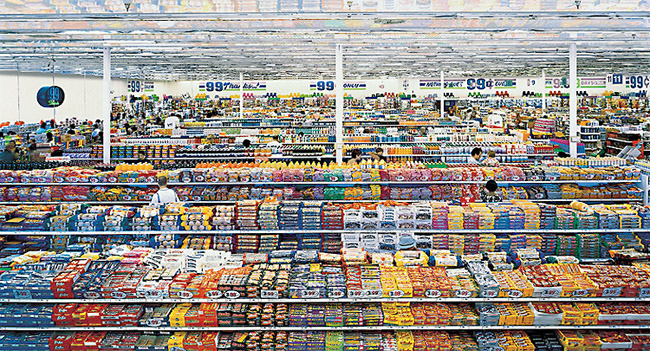
99 Cent/Andreas Gursky

At this point in reforming my shopping habits to make them more sustainable my main focus has been weeding out plastics. Here are a few strategies that have helped me along the way:

1. Produce is your friend and better than alternatives. Fresh produce requires no packaging. You may irritate the cashier or those waiting in line behind you as your loose oranges go rolling off the counter - I have - but that can easily be corrected for with a reusable bag. Furthermore, by committing to creating less waste your diet will likely grow more skewed toward fresh fruits and vegetables, which is hardly an undesirable side effect.

While you may be leaving the grocery store with less plastic and packaging, the question remains, however, whether those moves are good for the environment overall, especially if those oranges had to be shipped and preserved cross-country in order to reach your local vendor. To take it a step further and reduce energy demands and pollution stemming from food distribution you could start spending some more time at your local farmers market.

By purchasing from local farmers you can typically guard against the risk that your fresh produce polluted the environment more than the plastic-sealed variant would have. They are also one of the few places I know of that can offer dairy products that do not come in disposable plastic containers. This form of shopping moreover comes with the added benefits of supporting local businesses and developing a relationship with the entrepreneurs behind them, as elaborated upon in Colin Beavan's No Impact Man.

If you are interested in finding local resources for shopping sustainably, Sustainable Table's Shopping Guides are the best resource I have found so far. Although I have yet to decipher what rubric the site uses, if any, in deciding whether to include a business on it, each individual vendor provides specific information on the nature of their operations for you to decide for yourself whether they deserve your business. The site also provides links to online venues for identifying sustainable non-food products.

It is also worth noting that eating locally will only be an issue as long as our current energy economy does not fundamentally change. Once we make the transition to clean, renewable energy sources, the ecological impact of transportation and refrigeration will be a negligible issue and one of the few barriers to using it for the purposes of distributing food will hinge on whether those resources could be used more effectively elsewhere in improving the quality of our lives. In the meantime, choosing to consume locally will put pressure on transportation, refrigeration, and related services to utilize alternative energy sources and help make that possible future a reality.

2. If you can't get it fresh, get it canned. Or bottled. Just be sure the brand you settle on does not line its cans with plastic, as many unfortunately do. The beauty of cans and bottles is that they can be cans and bottles again. A plastic bottle almost never becomes a plastic bottle again.

3. Pasta boxes. Its ingredients may not be sourced locally, but pasta does come in paper boxers, which often contain recycled content and can then either be further recycled or thrown into a compost bin. Of course, substituting all our plastic with paper would not be much more commendable, so you also may resign yourself to purchasing grains from bulk bins with your own reusable bags.

4. Eggs. Somewhere I saw a graphic illustrating the general trend that the smaller the animal you consume, the smaller your carbon footprint (and those who consume no animals have got us all beat), which leads me to believe that eggs have even less impact. In my parts they come in recycled paper cartons, making the purchase that much more justifiable over the styrofoam and plastic-wrapped chicken further down the aisle. If you cannot give meat up or need the protein, you can usually get it paper-wrapped from a local butcher.

5. Baking soda. Is there anything this stuff can't clean? I am already using it in place of toothpaste and deodorant, with no adverse effects, mind you! Next is to test it as a shampoo, since it can apparently be used for that too.

It has been easy so far. I cannot say that I have felt particularly deprived at any point, but my feelings may change the longer I carry this on and the more I need to replenish diminishing stocks of other consumer goods, such as pens, my toothbrush and floss.

Luckily I am not pioneering this change in lifestyle. My Plastic-free Life is a blog documenting the author's own experience in this ordeal, one she has engaged herself in since 2007. I expect there is excellent guidance to be had there.

Friday, February 18, 2011

Approaching Zero Waste


A great deal of my current waste-reduction efforts has been inspired by No Impact Man, an experiment in reducing one's ecological footprint to zero or even positive effects conducted by Colin Beavan that has spawned a book and documentary. Producing no trash was the first of five steps on his path to having no net ecological impact. The other four were:

No carbon-producing transportation
Sustainable eating
Sustainable consumption
No carbon-producing energy

As for me I have already made a lot of progress in eliminating trash-producing decisions and have almost completely avoided the garbage can for about a month now. A few habits and resources have helped me along the way.

1. Make your trash can inaccessible. Early on I found that out of force of habit I was throwing peels and otherwise recyclable materials into the trash without even noticing it. I could not lock my trash can up entirely because my roommates still use it, but I did make it a point to put it out of reach each time I was cooking, which was the activity responsible for most of my waste.

2. Cut plastic out of your diet. Since I cannot be sure that the plastic I consume will be recycled, downcycled or discarded by materials recovery and recycling facilities, I generally refuse to buy it. This will become a problem when my pens run out - maybe I will just use pencils - but for the time being I am avoiding anything that comes in plastic packaging. That means no bagged vegetables or bread, no boxed cookies or crackers, no condiments or toiletries unless they come in glass, paper or metal containers.

3. Biodegradability. Let nature recycle for you. There is much less work on our end if we simply buy what can rot. Humanity has had this incredibly efficient waste disposal system available to it throughout our entire history, doing us a favor and saving us labor. It is a wonder why we started to break from it at all. By invoking biodegradable pathways you can ensure that nutrients and other resources get returned to the earth for use by other forms of life and future generations.

4. Worms. So maybe a heap of stinking vegetable bits in your backyard is less than desirable. That is certainly the case in my city where any set up of that sort would attract RATS. Luckily my roommate took the initiative and bought us worms for our own in-house worm bin. A little weird I know but it provides a convenient way for us to dispose of our organic trash and so far it has not led to any odors or bugs to complain about.

There is one major difference between my strategy and that of No Impact Man. I am not counting recyclables as waste. Beavan argues that the recycling industry uses energy and other resources that we need for other causes, but I am focusing more on preventing the contamination of the ecology with harmful waste products and consider employing resources in recycling preferable to many other industries. If it can be reintegrated into the production process and in one way or another come to constitute the same form it originally had I am willing to buy it. That is why I find the purchase and recycling of glass, paper and metal acceptable. Plastics, on the other hand, are more complicated and not truly recyclable in many cases, which is why I advocate forgoing them.

Making the decision to eliminate garbage from your lifestyle certainly demands more planning and selectivity than conventional consuming does, but it is not without its advantages. If the knowledge that you are making an effort to lead a more sustainable lifestyle is not enough, I would advise keeping in mind an important point that Beavan makes in his book. If we treat the moments of our daily lives as hassles and obstacles that need to make way for the next ones, then what are we living for?