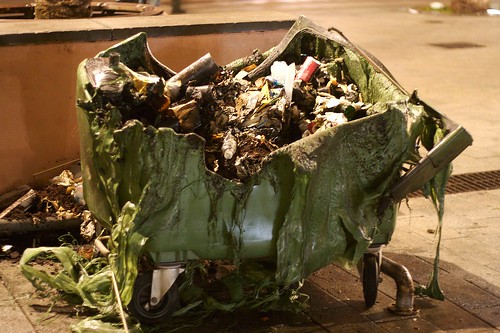
A great deal of my current waste-reduction efforts has been inspired by No Impact Man, an experiment in reducing one's ecological footprint to zero or even positive effects conducted by Colin Beavan that has spawned a book and documentary. Producing no trash was the first of five steps on his path to having no net ecological impact. The other four were:
No carbon-producing transportation
Sustainable eating
Sustainable consumption
No carbon-producing energy
As for me I have already made a lot of progress in eliminating trash-producing decisions and have almost completely avoided the garbage can for about a month now. A few habits and resources have helped me along the way.
1. Make your trash can inaccessible. Early on I found that out of force of habit I was throwing peels and otherwise recyclable materials into the trash without even noticing it. I could not lock my trash can up entirely because my roommates still use it, but I did make it a point to put it out of reach each time I was cooking, which was the activity responsible for most of my waste.
2. Cut plastic out of your diet. Since I cannot be sure that the plastic I consume will be recycled, downcycled or discarded by materials recovery and recycling facilities, I generally refuse to buy it. This will become a problem when my pens run out - maybe I will just use pencils - but for the time being I am avoiding anything that comes in plastic packaging. That means no bagged vegetables or bread, no boxed cookies or crackers, no condiments or toiletries unless they come in glass, paper or metal containers.
3. Biodegradability. Let nature recycle for you. There is much less work on our end if we simply buy what can rot. Humanity has had this incredibly efficient waste disposal system available to it throughout our entire history, doing us a favor and saving us labor. It is a wonder why we started to break from it at all. By invoking biodegradable pathways you can ensure that nutrients and other resources get returned to the earth for use by other forms of life and future generations.
4. Worms. So maybe a heap of stinking vegetable bits in your backyard is less than desirable. That is certainly the case in my city where any set up of that sort would attract RATS. Luckily my roommate took the initiative and bought us worms for our own in-house worm bin. A little weird I know but it provides a convenient way for us to dispose of our organic trash and so far it has not led to any odors or bugs to complain about.
There is one major difference between my strategy and that of No Impact Man. I am not counting recyclables as waste. Beavan argues that the recycling industry uses energy and other resources that we need for other causes, but I am focusing more on preventing the contamination of the ecology with harmful waste products and consider employing resources in recycling preferable to many other industries. If it can be reintegrated into the production process and in one way or another come to constitute the same form it originally had I am willing to buy it. That is why I find the purchase and recycling of glass, paper and metal acceptable. Plastics, on the other hand, are more complicated and not truly recyclable in many cases, which is why I advocate forgoing them.
Making the decision to eliminate garbage from your lifestyle certainly demands more planning and selectivity than conventional consuming does, but it is not without its advantages. If the knowledge that you are making an effort to lead a more sustainable lifestyle is not enough, I would advise keeping in mind an important point that Beavan makes in his book. If we treat the moments of our daily lives as hassles and obstacles that need to make way for the next ones, then what are we living for?
No carbon-producing transportation
Sustainable eating
Sustainable consumption
No carbon-producing energy
As for me I have already made a lot of progress in eliminating trash-producing decisions and have almost completely avoided the garbage can for about a month now. A few habits and resources have helped me along the way.
1. Make your trash can inaccessible. Early on I found that out of force of habit I was throwing peels and otherwise recyclable materials into the trash without even noticing it. I could not lock my trash can up entirely because my roommates still use it, but I did make it a point to put it out of reach each time I was cooking, which was the activity responsible for most of my waste.
2. Cut plastic out of your diet. Since I cannot be sure that the plastic I consume will be recycled, downcycled or discarded by materials recovery and recycling facilities, I generally refuse to buy it. This will become a problem when my pens run out - maybe I will just use pencils - but for the time being I am avoiding anything that comes in plastic packaging. That means no bagged vegetables or bread, no boxed cookies or crackers, no condiments or toiletries unless they come in glass, paper or metal containers.
3. Biodegradability. Let nature recycle for you. There is much less work on our end if we simply buy what can rot. Humanity has had this incredibly efficient waste disposal system available to it throughout our entire history, doing us a favor and saving us labor. It is a wonder why we started to break from it at all. By invoking biodegradable pathways you can ensure that nutrients and other resources get returned to the earth for use by other forms of life and future generations.
4. Worms. So maybe a heap of stinking vegetable bits in your backyard is less than desirable. That is certainly the case in my city where any set up of that sort would attract RATS. Luckily my roommate took the initiative and bought us worms for our own in-house worm bin. A little weird I know but it provides a convenient way for us to dispose of our organic trash and so far it has not led to any odors or bugs to complain about.
There is one major difference between my strategy and that of No Impact Man. I am not counting recyclables as waste. Beavan argues that the recycling industry uses energy and other resources that we need for other causes, but I am focusing more on preventing the contamination of the ecology with harmful waste products and consider employing resources in recycling preferable to many other industries. If it can be reintegrated into the production process and in one way or another come to constitute the same form it originally had I am willing to buy it. That is why I find the purchase and recycling of glass, paper and metal acceptable. Plastics, on the other hand, are more complicated and not truly recyclable in many cases, which is why I advocate forgoing them.
Making the decision to eliminate garbage from your lifestyle certainly demands more planning and selectivity than conventional consuming does, but it is not without its advantages. If the knowledge that you are making an effort to lead a more sustainable lifestyle is not enough, I would advise keeping in mind an important point that Beavan makes in his book. If we treat the moments of our daily lives as hassles and obstacles that need to make way for the next ones, then what are we living for?